The Old Language is an elevated style of written language used by Tetrians before War. The new era required fast and efficient communication more than ever, and the Old Language, with its intricate weave and complex set of rules, largely fell out of use. It’s not entirely forgotten, though: from time to time, someone digs up a new relic or a tome from The Library worthy of study, so experts on the topic do exist. And since it carries strong symbolic meaning, the Old Language is also sometimes used on ceremonial occasions.
Should you come across the Old Language in your travels and decide that you want to decipher it, a short guide below will come in handy.
Writing system
1 The writing system is RTL (right-to-left).
2 The Old Language was originally scriptio continua, but spaces were later added to improve readability. Other features of that style of writing, such as the lack of punctuation or capitalization, persisted. Notably, the articles are also absent (because I’m bad at them and hate them).
3 The language has a phonemic orthography — in most cases, a word is written just like it sounds, with each letter assigned to specific phonemes:
| The Old Language graphemes | Phonemes (IPA) | English graphemes |
|---|---|---|
 | /æ/, /ə/, /ʌ/, /ɑ:/ | A, E, O, U |
 | /b/ | B |
 | /s/, /θ/ | C, S, TH |
 | /d/ | D |
 | /ɛ/ | E, U |
 | /f/ | F |
 | /g/ | G |
 | /h/ | H |
 | /i:/, /ɪ/, /j/ | I, E, J, O, U, Y |
 | /aɪ/ | I, Y |
 | /dʒ/ | J, G |
| The Old Language graphemes | Phonemes (IPA) | English graphemes |
|---|---|---|
 | /k/ | K, C, Q, X |
 | /l/ | L |
 | /m/ | M |
 | /n/, /ŋ/ | N |
 | /ɒ/, /oʊ/, /ɔ:/ | O, A |
 | /p/ | P |
 | /r/ | R |
 | /t/ | T |
 | /ʊ/, /u:/, /w/ | U, O, W |
 | /v/ | V, F |
 | /z/, /ʒ/, /ð/ | Z, S, X, TH |
The table above mostly lists single-letter English graphemes for brevity, but you’ll also notice that less frequent diphthongs are absent; those are usually represented by di- or trigraph combinations in the Old Language:
| The Old Language combinations | Phonemes (English > The Old Language) | English graphemes examples |
|---|---|---|
| EI | /eɪ/ > /ɛ/ + /ɪ/ | A, A_E*, AI *The “magic e” pattern |
| OI | /ɔɪ/ > /ɒ/ + /ɪ/ | OI, OY |
| AU | /aʊ/ > /ɑ:/ + /ʊ/ | OU, OW |
| EA(R) | /eəʳ/ > /ɛ/ + /ə/ (+ /r/) | AIR, ARE, EAR |
| A(R) | /ɜ:ʳ/ > /ə/ (+ /r/) | IR, ER, UR |
| IA(R) | /ɪəʳ/ > /ɪ/ + /ə/ (+ /r/) | EAR, EER, ERE |
| UA(R) | /ʊəʳ/ > /ʊ/ + /ə/ (+ /r/) | URE, OUR |
Finally, a few more things to keep in mind:
Double consonants, even when they represent a single phoneme, are typically only truncated in less formal writing (so in Minotaur, Ollie only got one “l”).
Silent letters are omitted, though in the case of a silent “R”, this depends on the region (non-rhoticity!).
Just like almost any other writing system, the Old Language has its exceptions, few as they are. Notably, the word “Demon” is spelled with the letter for /ɛ/ rather than the monophthong /i:/ — possibly the result of the need to distinguish the word in the absence of capitalization (a dedicated symbol was also added — see next).
The /ʃ/ sound should really have its own grapheme (also used for /ʒ/ and in /tʃ/ > /t/ + /ʃ/), but I’ve spent way too much time on this already before realizing it  So for the moment (in the existing texts), it’s represented by the graphemes for /s/ + /h/ (or /t/ + /s/ + /h/ for /tʃ/). Perhaps /ɜ:/, being the distinctive vowel that it is, merits its own grapheme as well.
4 In addition to the main alphabet above, the Old Language features several special characters:
| The Old Language graphemes | English match |
|---|---|
 | EA |
 | ING |
 | Dome |
 | Demon |
As you can see, the EA and ING letter combinations both have dedicated graphemes that map directly to the English spellings, covering a range of sounds regardless of the specific phonemes produced.
The symbol for domes — originally a designation for Tetrian cities of significance — was slightly modified in the early post-War years, and has been used to refer to the domes since (though owing to its heritage, it is still sometimes used with the Cities of Old). The symbol for Demons, in the meantime, was obviously one of the last additions. Both are used before names, and in case with domes, the “of” preposition is usually omitted (unless there’s a further attribution, such as “dome of Nova sept”). A subtle difference in application is that there’s no need to spell the word “dome” in addition to the symbol, but this is frequently done for Demons.
It’s also worth noting that, though not a unique symbol, U is used not only as a letter, but for the words “U7”, “world” and “you” as well.
5 Let’s not forget about the numbers:
| The Old Language graphemes | English match |
|---|---|
 | 1 |
 | 2 |
 | 3 |
 | 4 |
 | 5 |
 | 6 |
 | 7 |
 | 8 |
 | 9 |
 | 0 |
6 Finally, it’s useful to keep in mind that, as the visual style of the Old Language lends itself well to ligatures, some are commonly used:
AT, ATE, ATTE, ATI, AV
FA
LL (when not truncated — see above)
TE, TI (with a monophthong “I” only), TS, TT
Test thyself
Fun, isn’t it? I bet you’re eager to apply all this newfound knowledge to practice! Well, I have just the thing. In one of the paths of his route, Richie Donovan from Minotaur finds himself in a small but cozy café in Soma DC:
1
2
3
4
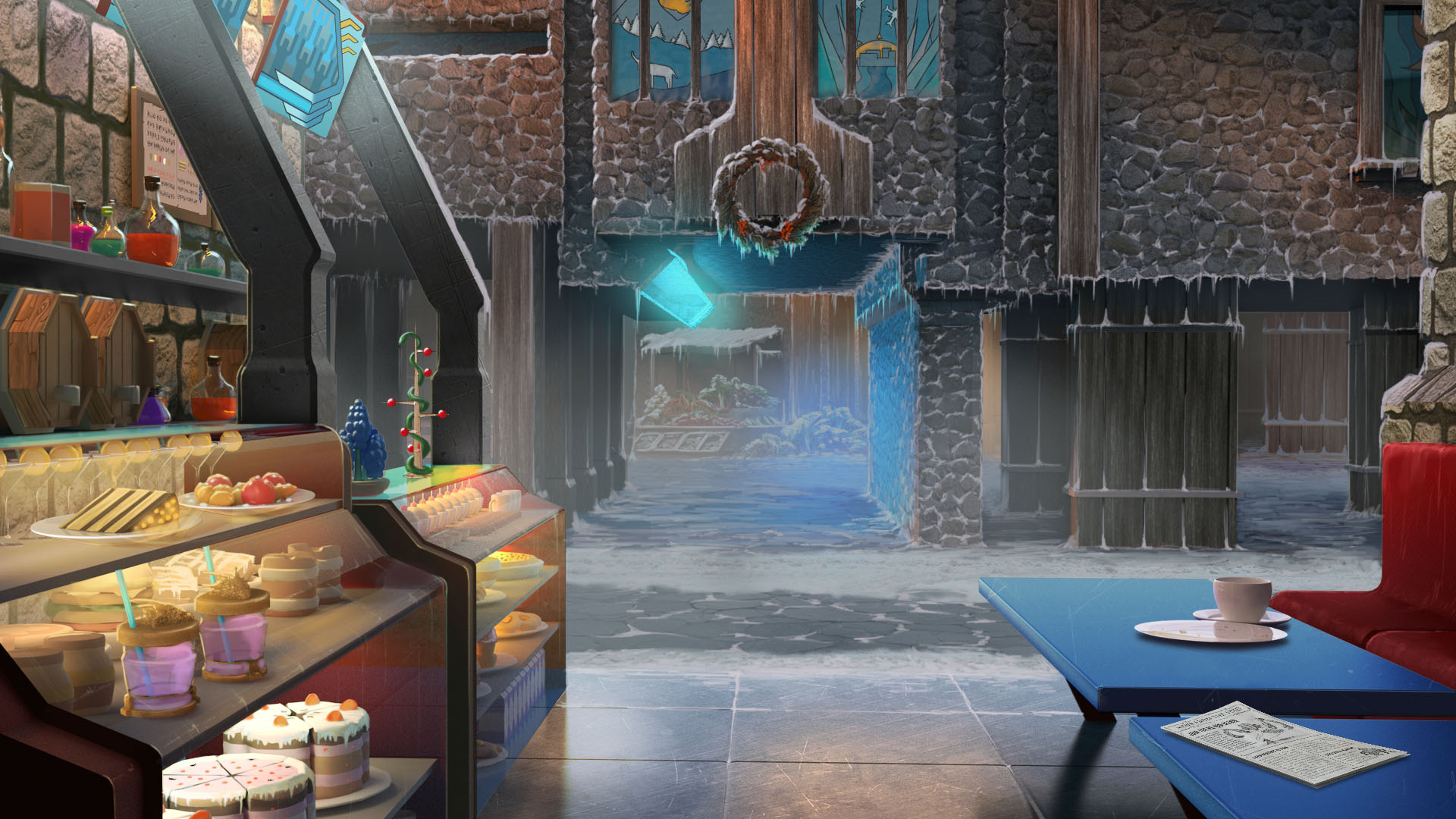
Just above the counter on the left, you can see a menu board with today’s specials. As is almost always the case with Minotaur (and U7 in general), even though it’s quite a small detail, we designed it thoroughly before adding it to the scene. Here it is in all its glory:
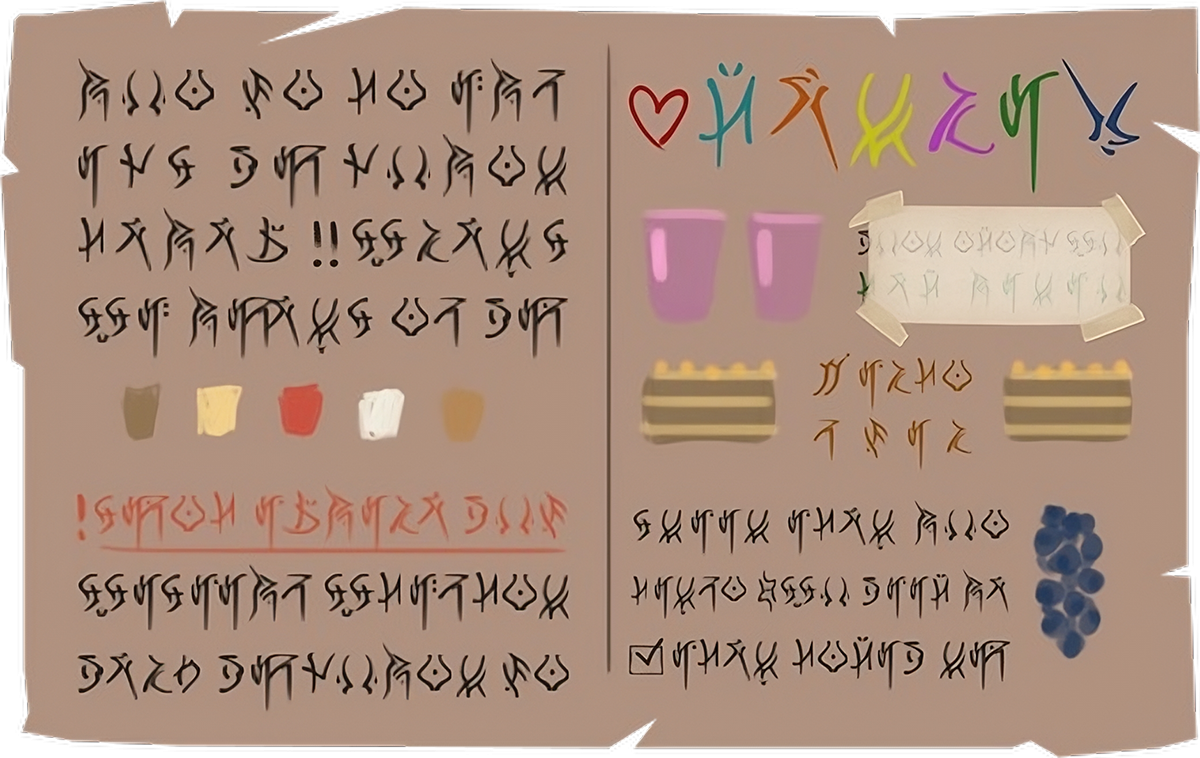
Now you can try and give it a go! Just keep in mind that the menu is informal in nature, and that it was written by an enthusiastic café owner rather than a professional scholar (if you’d like a more accurate and extensive reference, check out the transcriptions on the world wallpapers page). Good luck!